Quick answer
When air drying takes longer than your morning allows, a dryer can help you finish on time without making every wash a hot blowout. The American Academy of Dermatology (AAD) recommends air drying when possible and using the lowest heat setting when you use a dryer. For either routine, gently absorb water with a towel first; you can also let hair air dry for part of the routine, then finish on low heat.
Choose the routine that fits your day
Air drying avoids dryer heat, but it may take longer than you have. A dryer gives you more control over timing, and temperature and handling matter. You can choose differently from one wash to the next. Using a dryer does not mean you need a full brush blowout, and air drying does not require waiting indefinitely if it no longer fits your plans.

Think about what you want from the finish. If you want to keep your natural texture, you may prefer to leave your hair mostly undisturbed as it dries. If you need to shape it, a brush blowout is an additional styling choice. Simply drying your hair does not require shaping it with a brush.
Start with gentle towel drying
The AAD recommends wrapping hair in a towel to absorb water instead of rubbing it. That is a useful first step whichever method you choose. Handle the lengths gently rather than scrubbing them back and forth.
If you air dry, arrange your routine so you can leave the lengths relatively undisturbed. Detangling is a separate choice that depends on your texture; hair drying by itself does not require repeated brush-throughs. Avoid pulling harder if a section catches.
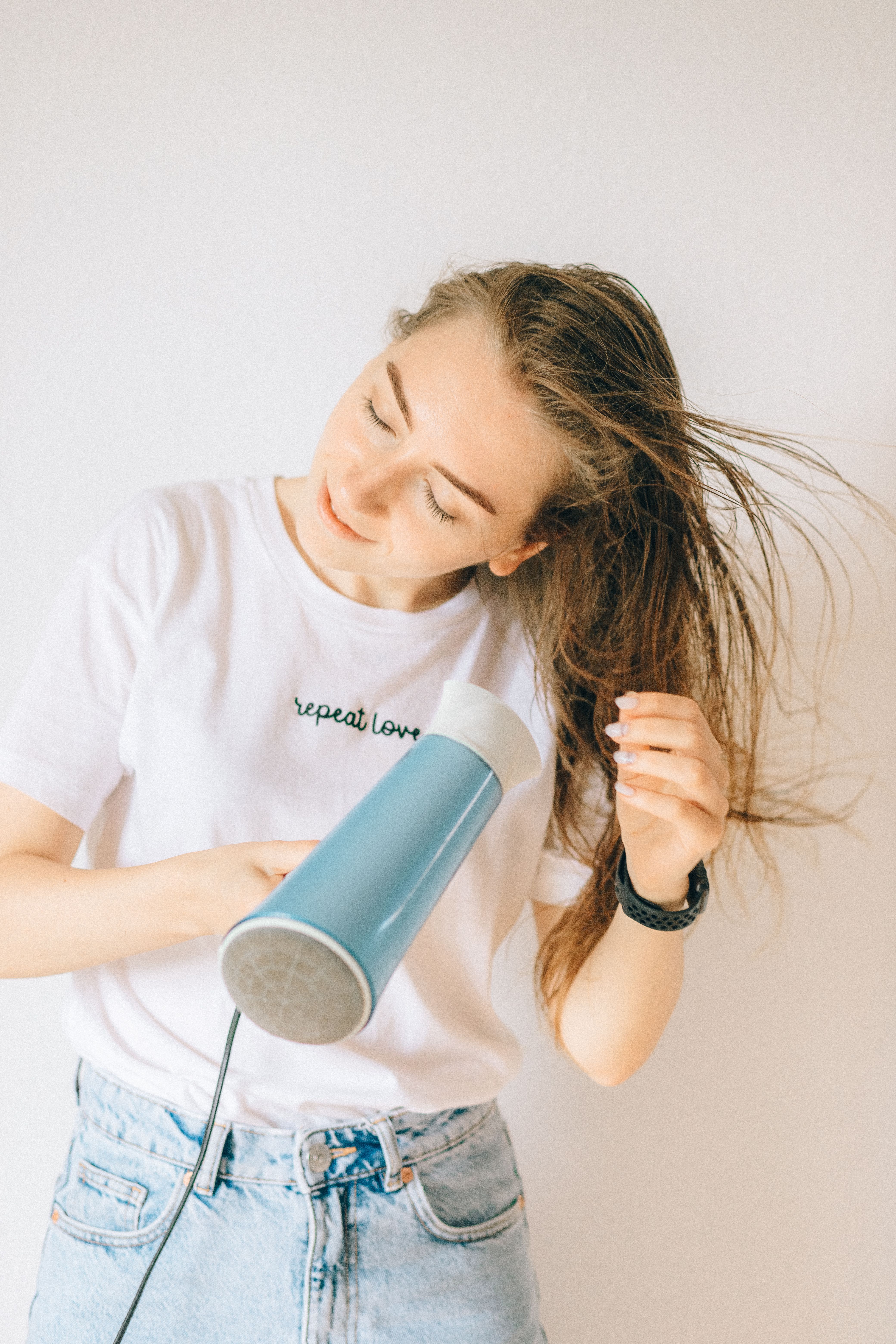
Illustrative towel-and-dryer photos; settings unidentified.
If you blow-dry, use the lowest heat
The AAD recommends the lowest heat setting and using heated tools less often. Follow your appliance’s instructions, including those for any attachment. Dryer settings vary, so “medium” does not indicate one standard temperature.
Keep the dryer moving rather than concentrating heat on one section, and leave space between the outlet and your hair. Do not press the nozzle onto the lengths to speed things up. If your goal is only to finish drying, you can skip the brush blowout. Repeatedly heating a section that already feels dry may also be unnecessary.
What the drying study can—and can’t—tell you
A 2011 study in Annals of Dermatology compared natural drying with dryer conditions at different distances and temperatures. Researchers tested chemically untreated hair tresses over 30 washing-and-drying cycles.
Hotter dryer conditions produced more surface damage. The naturally dried group showed a change in the cell membrane complex, an internal structure between hair cells; that group took more than two hours to dry. Under the study’s test conditions, the authors suggested that a moving dryer held 15 centimeters away caused less damage than natural drying.
Those results come from a controlled hair-fiber experiment, not a clinical trial of everyday routines. They do not show that air drying is always harmful or that blow drying is damage-free. The 15-centimeter distance is not a guaranteed safe setting for every dryer. The authors called for more evaluation of prolonged wet conditions, so the findings do not establish a universal winner.
Try a simple combination
When time allows, gently absorb water with a towel and let your hair air dry. When you need to get ready sooner, you could let it air dry for part of your routine, then finish with the dryer on its lowest heat setting. There is no need to estimate a dryness percentage or follow a fixed waiting time.
Pay attention to whether you are repeatedly heating the same sections or tugging at tangles. Change one part of your routine at a time to see what feels more manageable. Smoothness is not a measure of microscopic damage. A conventional hair dryer also has different operating requirements from a flat iron used later for styling.
If breakage or thinning remains a concern after gentler care, the AAD recommends seeing a dermatologist. For everyday drying, focus on gentle towel handling, less unnecessary heat and a routine that works with your day.
Read next
Sources
- AAD: How to Stop Damaging Your Hair
- Annals of Dermatology: Hair Shaft Damage from Heat and Drying Time of Hair Dryer
Image credits
- Featured image: pexels.com (original image page)
- Body image 1: pexels.com (original image page)